
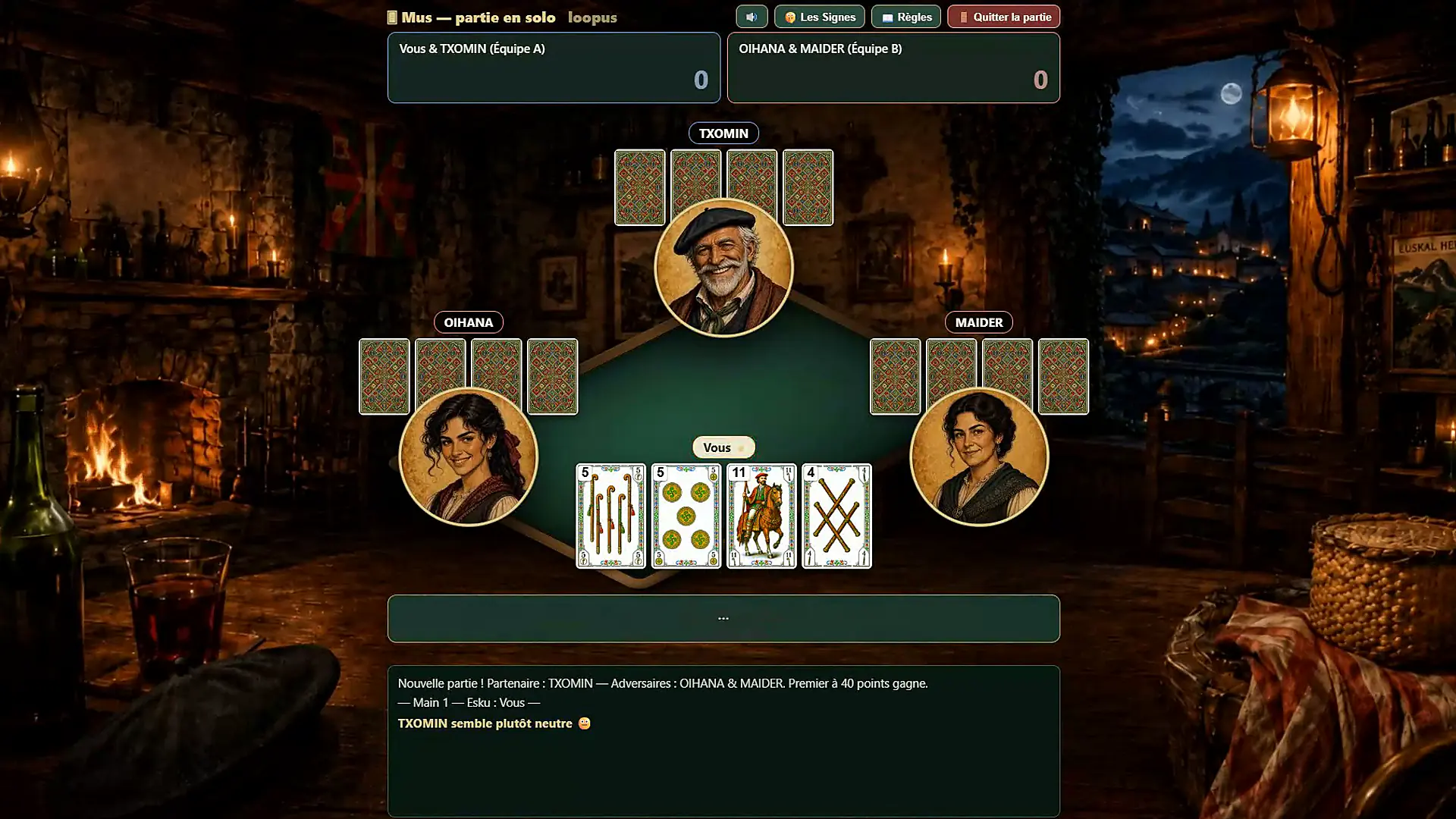
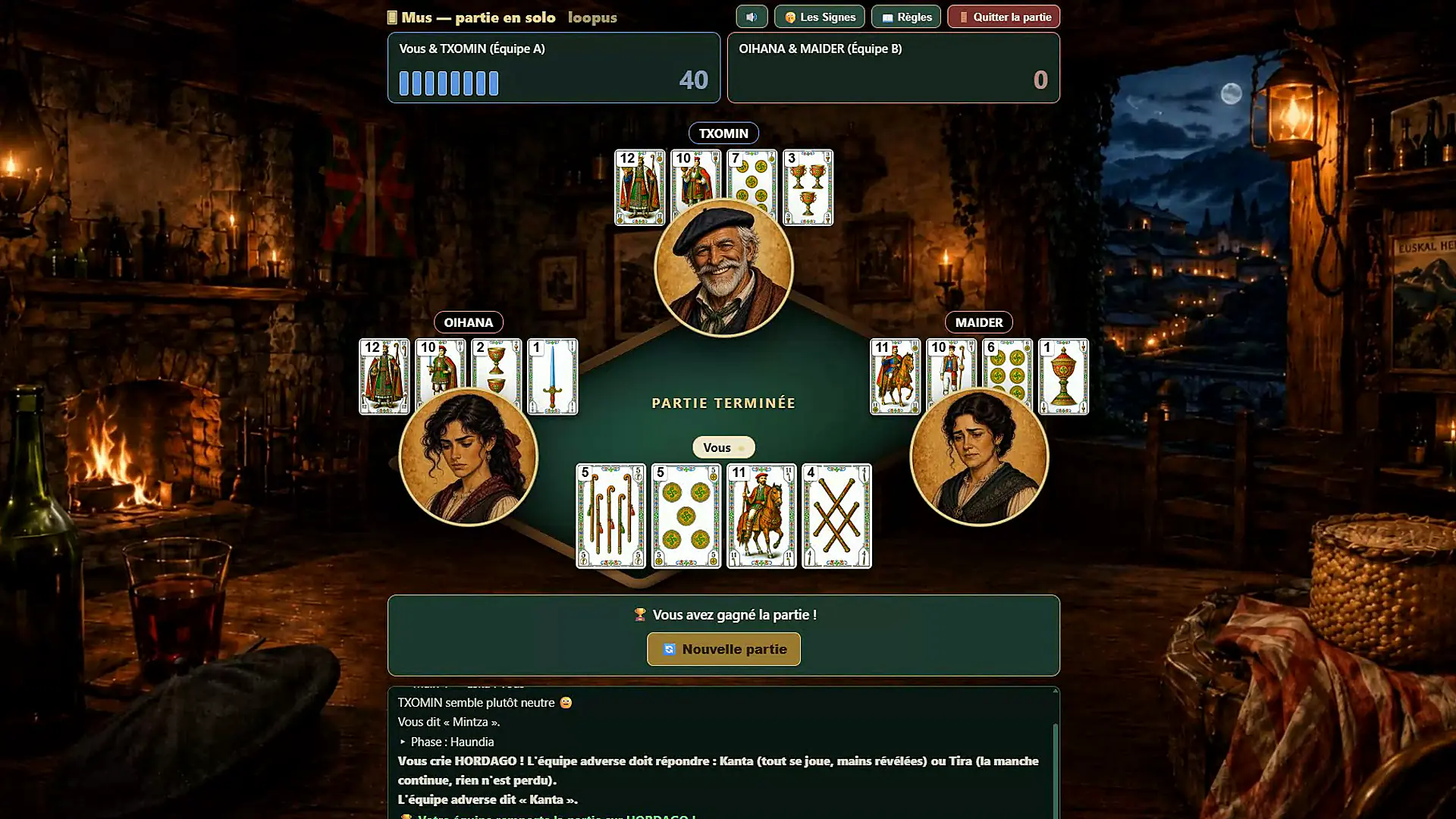
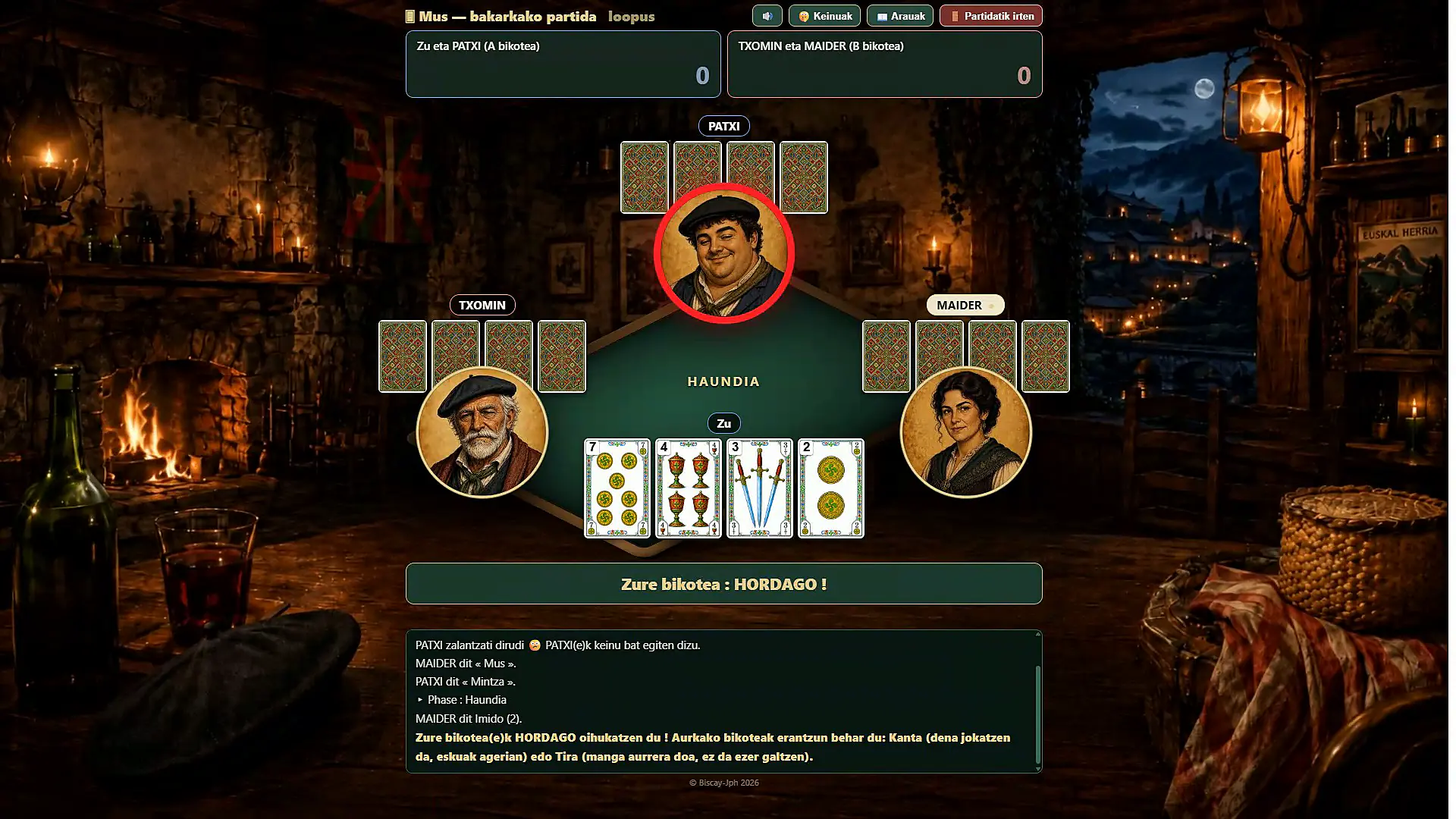
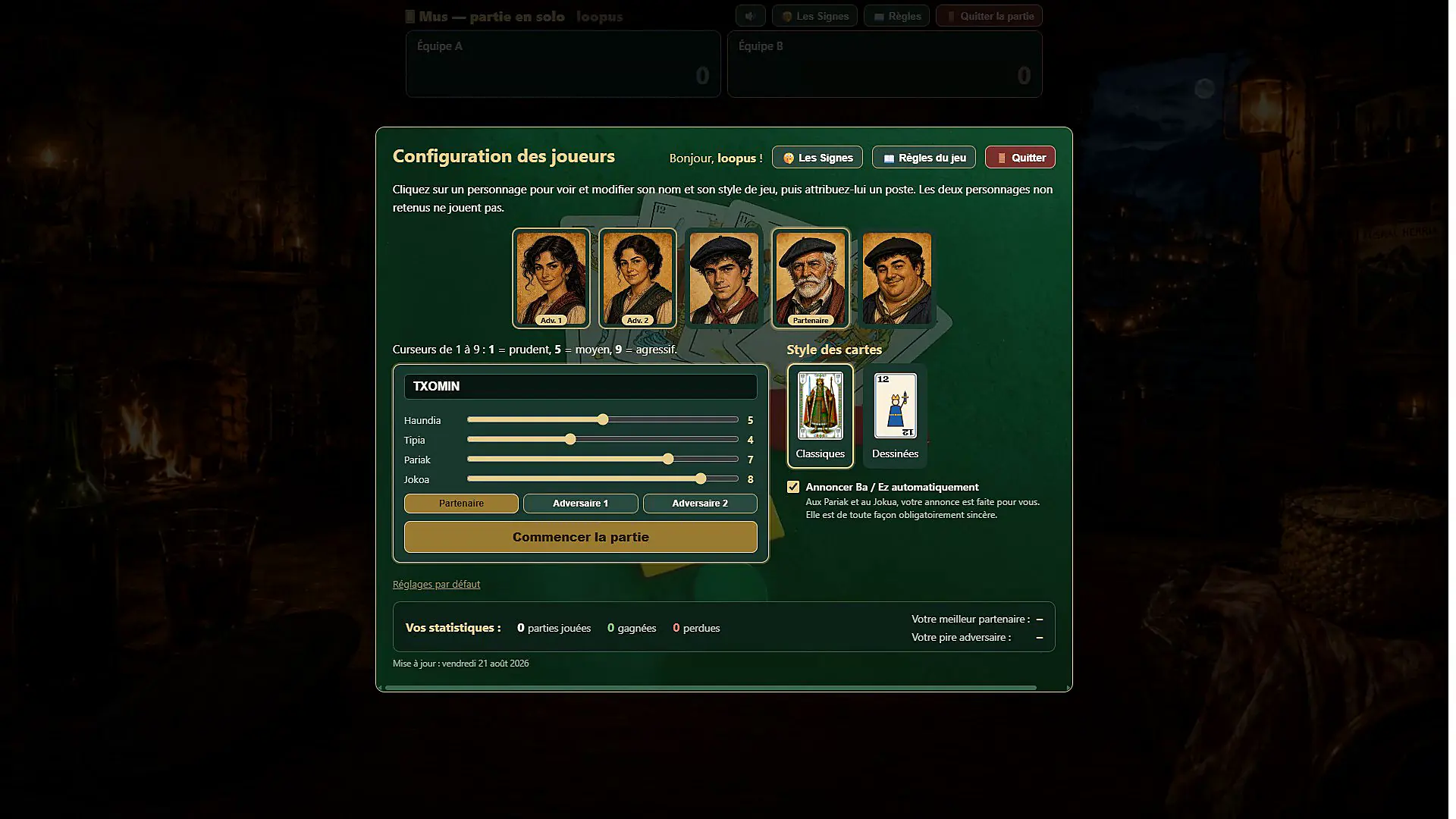
Mus is the emblematic card game of the Basque Country: four players, two teams, a 40-card Spanish deck and four betting phases — Haundia, Tipia, Pariak and Jokoa. Biscay Jph set out to build an online version faithful to the real rules, playable solo against AI-driven opponents and available in French, Spanish, Basque and English. I joined the project to build its entire visual world: giving the game the grain, the light and the faces of a real Mus played at the back of a Basque tavern on a winter evening. Then, once the game was online, to give it a voice: the videos that explain it and get it known, in each of its languages.
The result: five animated characters who genuinely hold their place at the table — smiling, hesitating, signalling to their partner, taking defeat — a complete 40-card deck designed and produced from scratch, an animated setting that establishes the tavern atmosphere from the very first second, and a YouTube channel fed by AI agents: trailers and twenty-minute tutorials edited, subtitled and ready to publish.
The heart of the visual work is the signs. In Mus, the two partners of a team communicate through discreet signals, and they had to read instantly on screen without ever becoming cartoonish: a wink, a stuck-out tongue, a bitten lower lip, raised eyebrows. So I designed each character — Txomin, Oihana, Maider, Bixente and Patxi — with their own range of animated expressions, from a neutral face to the tell that gives a hand away, and on to the signs sent to a partner while the opponents look elsewhere. Alongside the cast, I designed and produced the complete deck: the 40 cards across the four suits — oros, copas, espadas, bastos — and the shared card back, built to stay legible both in hand and at the small size of a card laid on the baize. Finally I composed the animated tavern setting, with its fireplace, oil lamp, the ikurriña on the wall and the village glimmering in the night behind the window, then extended that world into graphics for the game's YouTube channel. The second part of the job came after launch: getting the game known. Rather than edit every video by hand, I built AI agent workflows that own the whole production chain — script writing, voice-over, in-game footage, editing, subtitles, a looped score ducked under the voice, thumbnail and a YouTube publication sheet with title, description, timestamped chapters and keywords. Those workflows shipped the game's trailers in French, Spanish and Basque, in 16:9 and 9:16, then two full tutorials — “Comment jouer au Mus” and “Cómo jugar al Mus”, nineteen and twenty minutes — each cut both as a single film and in two parts. Replaying the same pipeline in another language yields a whole film again: that is what makes the game reachable for the Spanish-speaking audience, far larger than the French one, without multiplying the work by as much.